
The new way to learn Spanish fast
Learn to speak Spanish in less time with our 30-day
conversational Spanish course.
Your Roadmap to Speaking Conversational Spanish
A Step by Step Approach
Let's face it: learning a foreign language is not easy.
I learned that the hard way after I received an opportunity to spend a year living in South America. Since I had taken Spanish for years in high school and college, I assumed that I would be meeting people and making friends in Spanish in no time.
Boy, was I wrong. After four months of living in South America, I was still barely able to have a basic conversation in Spanish. Although I could quote my grammar textbook's explanation of the use of the imperfect subjunctive by heart, I was useless when it came to actually conversing in Spanish.
Walking into stores or restaurants, I was mostly reduced to grunting and pointing at what I wanted. I was not able to make friends, talk to girls, or have any significant social interaction with the locals.
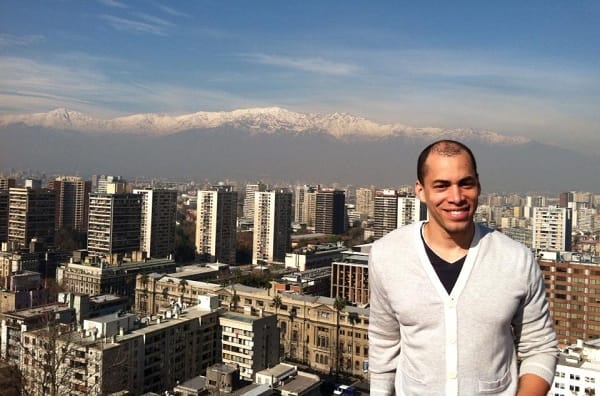
Mo Tahiti, Founder of One Month Lingo, in Santiago, Chile
Finally, after significant trial and error, I stumbled upon a series of techniques that rapidly improved my ability to communicate in Spanish.
The most important thing I discovered was that in order to improve my ability to converse, I needed to spend most of my time speaking and listening. Once I replaced the time I was spending on flashcards and grammar drills with time actively listening and speaking in Spanish, I began to see dramatic improvement.
My next big discovery was that I could get by in many conversations using relatively little grammar. It turned out that it didn't matter if I sometimes used the preterite where I should have used the imperfect, or if I used the indicative instead of the subjunctive -- people could still understand what I was trying to say.
Changing my approach to account for these principles freed me from the "paralysis by analysis" that had been making my speech slow and stunted and finally allowed me to start speaking more fluently and more confidently.
One Month Spanish incorporates these principles into a step-by-step Spanish conversation course designed to get you speaking Spanish in the shortest time possible.
But first a warning: this approach is not for everyone. If you are looking for something that is "easy" and doesn't require much effort or attention, or if you want cute games or "apps" that require no more than clicking a mouse, then this isin't for you.
But if you are you are ready to finally learn how to speak (not just read) Spanish, and are willing to put in a bit of time and effort each day, read on to find out how you can quickly build your confidence and improve your ability to converse in Spanish.

About the Course
One Month Spanish is an online course designed to teach you conversational Spanish over 30 lessons.
Each lesson contains a series of audio exercises designed to train your brain how to listen and respond naturally in Spanish. You'll hear native Spanish speakers conversing in common scenarios (e.g. going to the store, checking into an hotel), sequenced to progressively improve your ability to understand native Spanish conversation.
The Four Keys to Our Rapid Language Acquisition Method
Dialogue-centered - Our dialogue-centric approach helps you to learn all of the necessary grammar, vocabulary, and pronunciation within the context of real conversation - not flashcards or grammar books.
Audio-based - by working with audio, you master the ability to speak and understand oral Spanish, not just recognize words on paper.
Guided imitation - active listening and repetition of native Spanish speakers improves pronunciation and helps achieve fluency.
Progressive learning - each new lesson builds upon prior material to constantly reinforce what you've learned.
No-nonsense Learning Approach
Most language courses are designed for casual learners who are content to slowly improve their Spanish skills over months or years. One Month Spanish is designed for serious learners who are looking to rapidly improve their Spanish speaking skills.
Based on a proven methodology used to teach FBI agents, and diplomats, One Month Spanish is ideal for travelers, foreign exchange students and others who need to rapidly improve their language skills in order to survive in a Spanish speaking country.


“After months of struggling to understand basic conversation,
I was finally able to make Spanish speaking friends.”
- Belinda Lui, Santiago, Chile
Learn From Native Spanish Speakers
One Month Spanish's dialogue-based learning approach helps you learn Spanish quickly through frequent exposure to native Spanish conversation. This approach allows you to learn naturally, with less reliance on rote memorization or abstract grammar.
Each lesson comes with reinforcing audio drills to help you master core skills and more easily recall what you have learned in real conversation.
Who the course is for:
You're about to take a trip to a foreign country
You've tried other methods but still struggle with actual conversation
You already know the basics but need to improve conversational ability
You want to develop real-world language skills rather than memorize lots of rules
Check Out What People Are Saying About
One Month Lingo:

Tim Nolan, Mexico
This completely changed the way I thought about “studying” Spanish. Once you get used to it, this just makes way more sense.
Matt Hines, New York
I was skeptical at first, but after a couple weeks of using the methods everything started to “click” … I learned more practical skills than entire year of Spanish classes.
Melissa Brooks, Buenos Aires
I already knew the basics, but I was never able to figure out the conversational aspects. I wasted so much time with Rosetta Stone... I wish I had found this sooner.

Sandy Kolesar, California
I would definitely recommend this to anyone looking for a fresh approach to learning Spanish.